
The trade gap - difference between imports and exports - was $11.39 billion in March 2015.
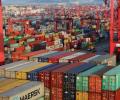
India's exports grew by 67.39 per cent to $32.21 billion in May driven by healthy growth in sectors such as engineering, pharmaceuticals, petroleum products and chemicals, according government data released on Wednesday. Exports in May last year stood at $19.24 billion and in May 2019 it was at $29.85 billion, the commerce ministry's preliminary data showed. Imports in May rose by 68.54 per cent to $38.53 billion, from $22.86 billion in May 2020. In May 2019, imports stood at $46.68 billion.
India's exports rose marginally by 1.62 per cent to $33.92 billion, while trade deficit more than doubled to $27.98 billion in August due to increased crude oil imports, commerce ministry data said on Wednesday. The revised data showed that imports rose by 37.28 per cent to $61.9 billion in August this year. The preliminary data released by the ministry on September 3 had shown a 1.15 per cent decline in exports to $33 billion in August.

Indian stock markets experienced a significant sell-off, with the Sensex tumbling over 1,300 points, driven by escalating crude oil prices due to US-Iran tensions and Prime Minister Narendra Modi's call for austerity measures, which amplified investor concerns about India's economic outlook.

Indian rupee slipping below the record 88 level against the US dollar will enhance price competitiveness of Indian products in global markets and help exporters diversify beyond the US market, say exporters. However, import-dependent sectors such as gems and jewellery, petroleum and electronics may see lower benefits due to a rise in input costs, they stated.
India's merchandise exports in February shrank for the 15th straight month on continued weak demand from Europe, the South Asian nation's biggest market.
Last month's deficit stood at $9.22 billion, the trade ministry said, compared with $10.56 billion in October -- a traditional gold buying season.

Indian oil marketing companies are incurring significant losses, selling petrol at a Rs 14 per litre loss and diesel at Rs 18 per litre, as elevated global crude oil prices, exacerbated by the West Asia crisis, outpace capped retail fuel rates, according to rating agency Icra.

Lakshya Sen lost a hard-fought match to Li Shi Feng in their Thomas Cup tie, putting India behind China 0-1. Despite a strong showing at the All England Championships, Lakshya couldn't replicate his success, losing in three games.

India has been struggling to control the current account deficit that hit an all-time high of 6.7 percent of GDP in the December quarter.
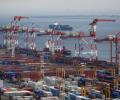
Exports of petroleum products, chemicals, pharmaceuticals, gems and jewellery, and engineering goods registered a positive growth.

India's exports fell 5.12 per cent to $24.89 billion in October, after recording positive growth in September, on account of drop in shipments of petroleum products, gems and jewellery, leather and engineering goods, according to government data released on Friday. Trade deficit in October narrowed to $8.71 billion as against $11.75 billion in the corresponding month a year ago. Imports also fell 11.53 per cent to $33.6 billion (year-on-year) in October 2020.

Indian benchmark stock indices, Sensex and Nifty, closed nearly 1 per cent lower due to surging crude oil prices, weak global market trends, and significant foreign fund outflows, with geopolitical tensions and inflation concerns further dampening investor sentiment.

Gold imports, however, grew 10.47 per cent to $ 2.42 billion in May.

Export sectors that showed positive growth last month included chemical, iron ore, electronics, marine products and pharmaceuticals. Decline in overall imports, including oil and gold, led to narrowing of trade deficit.

Gold imports climbed 349.22 per cent to $12.07 billion in January, while silver imports rose 127 per cent to $2 billion.

'In all these years of rupee depreciation, of rising oil prices, of inflation caused by import dependence, not one leader had the courage to look the people in the eye and say: Please do this for your country.'

Ayush Shetty's comeback win keeps India in the contest after Lakshya Sen and the doubles pair of Satwiksairaj Rankireddy and Chirag Shetty lost their matches against China in the Thomas Cup Finals.

The country's trade deficit widened yet again, to $9.7 billion (Rs 43,500 crore) in October, compared to $9.12 billion in the earlier month. Also, after a span of three to four years, merchandise exports have surpassed the growth rate of imports in the same month.

Imports dropped 13.16 per cent year-on-year
Export sectors that recorded positive growth in the last month include iron ore, electronic goods, spices, and marine products.

Assam's Priyanuj Bhattacharya and J&K's Ritvik Gupta emerged victorious in the Under-19 and Under-17 Boys' Singles finals respectively at the Junior and Youth National Table Tennis Championships.

Imports reached $488.6 billion, leaving a trade deficit of $184.9 billion, Commerce Secretary Rahul Khullar said in New Delhi on Thursday.

Putin's State visit will centre on fixing the huge India-Russia trade imbalance, with both sides pushing to lower duties, ease non-tariff barriers, and seal a landmark mobility pact to send more Indian workers to Russia.
Trade deficit increased to $17.933 billion during the quarter ended September 2006, according to data released the Reserve Bank of India on Friday.
India's exports in January rose 25.28 per cent to $34.50 billion on account of healthy performance by mainly engineering, petroleum and gems and jewellery sectors, even as trade deficit widened to 17.43 billion, according to data released by the commerce ministry on Tuesday. Imports grew by 23.54 per cent to $51.93 billion during the month under review. Trade deficit, difference between imports and exports, stood at $14.50 bn in January 2021.
The deficit for the month stood at $6.7 billion, the lowest level since March 2011, compared with $10.9 billion in August, the trade ministry said.

Under the TMC, Bengal has seen expansion of welfare, but not big-ticket private investment.

Lakshya Sen and the doubles pair of Satwiksairaj Rankireddy and Chirag Shetty suffered narrow losses as India trailed 0-2 against China in their final Group A tie of the Thomas Cup Finals.
Indians' hunger for gold has made it the second biggest item, after crude oil, in the country's import basket.

Exports in January 2014 stood at $26.89 billion.
India's trade deficit increased to $6.20 billion in October, up sharply from $2.93 billion in October 2005 as demand for imports in the world's second-fastest-growing major economy outstripped exports.

India's merchandise exports jumped 27.16 per cent to $30.04 billion in November on the back of good performance by sectors like petroleum products, engineering goods and electronic items, official data showed on Tuesday. The exports stood at $23.62 billion in November 2020. Imports in November were at $52.94 billion, showing an increase of 56.58 per cent over inbound shipments of $33.81 billion in the year-ago month.

India may adopt a "calibrated" and a "step-by-step" approach to easing norms on investments originating from China, Union Commerce and Industry Minister Piyush Goyal said on Tuesday. He was in a conversation with A K Bhattacharya on Day 1 of Business Standard's two-day annual event, Manthan 2026. The minister said foreign direct investment (FDI) from China was certainly not "banned", but it goes through an approval process. "The government's approach at the moment is to accelerate the approval process."

If the conflict continues for a prolonged period, State-run oil companies may have to review retail fuel prices accordingly.

A new poll indicates that President Donald Trump's approval rating is suffering as economic anxieties and the rising cost of living weigh heavily on US voters, revealing deep political divides and widespread dissatisfaction with the government.
India's balance of payments for the first quarter of this fiscal showed a three-fold increase in deficit in trade balance at $15.8 billion against $5.1 billion in the same period last fiscal.

Imports during the first month of the current fiscal aggregated to $37.9 billion, leaving a trade a deficit of $13.4 billion.

The Indian rupee rebounded against the US dollar after the Reserve Bank of India (RBI) restricted banks' net open positions in dollars. This move prompted banks to sell dollars, providing temporary support for the rupee amidst ongoing geopolitical tensions and rising oil prices.

'The trade deficit in some sectors is huge and that is an area of opportunity to localise.'
